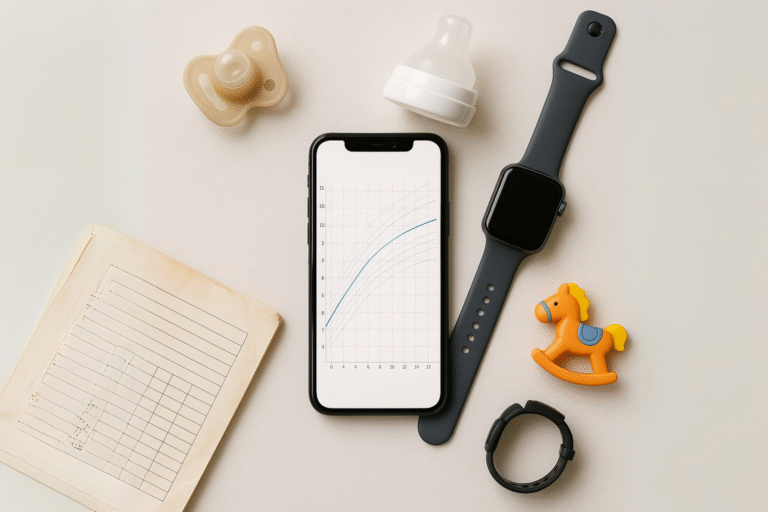

Parents trust that every time their child steps on a clinic scale or stands tall against the measurement board, those numbers are captured forever. We assume the system is complete, continuous, and ready to reveal health trends whenever needed. But here’s the truth: your paediatric growth data is probably not as complete as you think — and that matters more than most families realize.
This post explores how paediatric growth data is collected, where the gaps appear, and how families can bridge those gaps with simple, consistent tracking. Because when it comes to your child’s health story, every data point has meaning — and you deserve access to all of it.
The Hidden Gap in Paediatric Growth Data Tracking
When we hear “growth chart,” we imagine a perfect line that clinics maintain carefully from birth to adolescence. In practice, the system is far less tidy. A major study published in BMC Primary Care found that most children do not have complete, continuous measurements in their medical record during their first two years of life.
The numbers are surprising. According to the study, only 13.7% of children had all recommended measurements (weight, height/length, and head circumference) recorded at each of their well-child visits. Even more striking, only 51.4% of children had their head circumference documented at all.
These gaps aren’t caused by negligence — they happen because clinics are busy, providers vary, and health systems aren’t always optimized for consistent data entry. But for parents, this means something important: you may be missing key pieces of your child’s growth picture, even if you attend every visit.
“Only 67.5% of children had at least one complete growth measurement recorded, and documentation varied widely across providers.”
This is not a criticism of healthcare providers. It is a systemic pattern, and it creates a disconnect between families and the data that should help guide their child’s long-term health.
That disconnect is exactly the gap Ezm5 aims to help families solve.
Why Incomplete Growth Charts Matter More Than You Expect
A single measurement is just a number. But growth data becomes meaningful when you can see patterns — the arc of a child’s physical development. Missing measurements make it harder to interpret:
- Growth velocity (how fast they’re growing)
- Early signs of nutritional issues
- Subtle deviations from expected curves
- How growth compares across months or years
- The effect of illnesses, sleep changes, or dietary transitions
Without consistent data, even a skilled clinician has less context.
Imagine tracking your child’s height only every third visit. The line on the chart becomes jagged and less reliable. You lose the ability to see the subtle but important changes that help identify concerns early — the kind of concerns that are easiest to address when spotted promptly.
For many parents, the real surprise is that even if you attend all the checkups, your child’s growth chart may not be complete. The system wasn’t designed for parents to have real-time visibility — it was designed for clinical snapshots.
But your child’s health doesn’t happen in snapshots. It unfolds every day.
How Parents Can Reconnect With Their Paediatric Growth Data
Today’s families track everything: sleep cycles, step counts, flights, expenses, and school messages. Yet for something as fundamental as a child’s growth chart, most parents still rely on paper booklets, scattered PDFs, or clinic systems they can’t fully access.
This is where a new approach makes all the difference.
How to take control of your child’s paediatric growth data:
- Track growth consistently at home
A simple digital log ensures that no measurement is forgotten. Even if the clinic misses a head circumference or length, you don’t. - Store all data in one place
Parents often have numbers in text messages, PDFs in emails, notes on their phone, and clinic portals. Unifying that information gives you a full history — not fragments. - Make the data accessible forever
Schools, specialists, and even routine appointments may ask for past growth data. Having everything organized means you can share or review it instantly. - Combine clinic data with your own measurements
Home measurements can strengthen and clarify the clinic’s growth chart. They don’t replace medical guidance — they enrich it. - Visualize trends, not isolated points
Seeing the curve over months or years is what reveals the real story. Every little change is clearer when the data is complete.
If you want to understand what those curves, percentiles, and patterns actually mean, this post “What a Growth Chart Really Tells You About Your Child’s Health” breaks it down in a simple and practical way.
Ezm5 was built exactly for this purpose: to give families a digital health vault where growth measurements, lab tests, and clinical files stay organized, structured, and available at any time. Not a replacement for healthcare — but a companion to it.
The Real Power of a Complete Growth Story
When parents have clear, continuous paediatric growth data, the benefits are both practical and emotional.
You worry less when the numbers make sense.
You ask better questions at checkups.
You catch inconsistencies early.
And you build a health record that supports your child across school years, sports, and specialist consultations.
Most importantly, you gain something families rarely talk about: health continuity. A full, lifelong picture of your child’s development — not scattered files that disappear with time.
This is the future of paediatric health tracking: families having ownership of the data that shapes their decisions, while healthcare professionals benefit from more complete information.
At Ezm5, our mission is simple: make that future accessible to everyone. By helping parents collect, store, and understand their child’s data today, we create a more informed, more empowered generation of families tomorrow.
Your Questions, Answered
Why is paediatric growth data often incomplete?
Because clinics vary in how they document height, weight, and head circumference. The study referenced showed that only a small percentage of children have complete measurements recorded at all recommended visits.
How can I track my child’s growth more accurately?
Track measurements regularly at home, store everything in one place, and combine your records with clinic data. A digital tool like Ezm5 helps unify the full history.
What’s the benefit of having all my child’s growth data together?
It lets you see trends, detect issues earlier, and share information easily with schools or doctors. A complete record gives you confidence and clarity.